Understanding elimination trials
An elimination trial is used by your vet to discover and classify allergies. Your vet may have suggested an elimination trial (also known as a dietary or food trial) because they are worried your dog has a food allergy due to symptoms common of an allergic reaction.
There are different types of allergy to be aware of. These include:
- Food allergies
- Environmental allergies (your vet may have talked about atopic dermatitis)
- Combined allergies (allergy to both certain foods AND something in the environment)
Fleas, mites, and combined allergies are three common causes of reactions in dog that a vet is likely to see when you visit your veterinary practice.
How does an elimination trial work?
Put simply – you switch your dog to a diet that is certain not to contain any allergy-containing ingredients – these are often called exclusion diets. You will then see what effect that has on their symptoms and tell you one of three things:
- If your dog's symptoms get no better, then it's almost certain that they are allergic to something other than food, as the exclusion diet is highly unlikely to be causing the problem.
- If your dog's symptoms clear up completely, then it's almost certain that they are allergic to something that was in the diet they were eating.
- If your dog's symptoms improve a bit, then it's probably the case that they have a combined allergy – an allergy to both food and something in the environment.
Exclusion diets for dogs
An exclusion diet is one that is almost certain to contain no allergen-causing ingredients.
It is almost always the animal protein that triggers an allergic reaction in dogs. There is a common misconception that grains are a major cause of allergy in dogs and dogs should eat a grain-free diet. The reality is that, while dogs can be allergic to grains, it is incredibly rare.
There are two different ways of making sure that exclusion diets contain no allergy-triggering ingredients:
Novel proteins: An allergic response occurs when the immune system sees a protein as harmful and reacts to it. This means that a novel protein – that their immune system has never seen before – is very unlikely to be seen as a threat and trigger that immune system allergic response. If your dog has been fed the same things for most of their life, then it is easy to find something they have never eaten before. However, if your dog has been fed lots of different proteins – either through their food or the treats and snacks they have eaten – then it can be quite difficult to find something that you can be certain their body has never seen.
Hydrolysed diets: Proteins are made up of a mix of amino acids with each different protein having its own unique combination of amino acids. Hydrolyzation cuts the protein into small pieces so that the immune system doesn't recognize them. By cutting the protein into small pieces, the amino acid mix is changed – making it something the immune system has never seen before.
Are there alternatives to elimination trials
The short answer is no. There are blood tests, but they are still not accurate enough. These tests have been shown to be particularly prone to false positives – a result that says your dog is allergic to something that they are actually OK with – but also suffer from false negatives – where they tell you that your dog is OK with something that is actually a problem.
The elimination trial is still the best and most accurate way of saying whether your dog has a food allergy.
Elimination trial phases
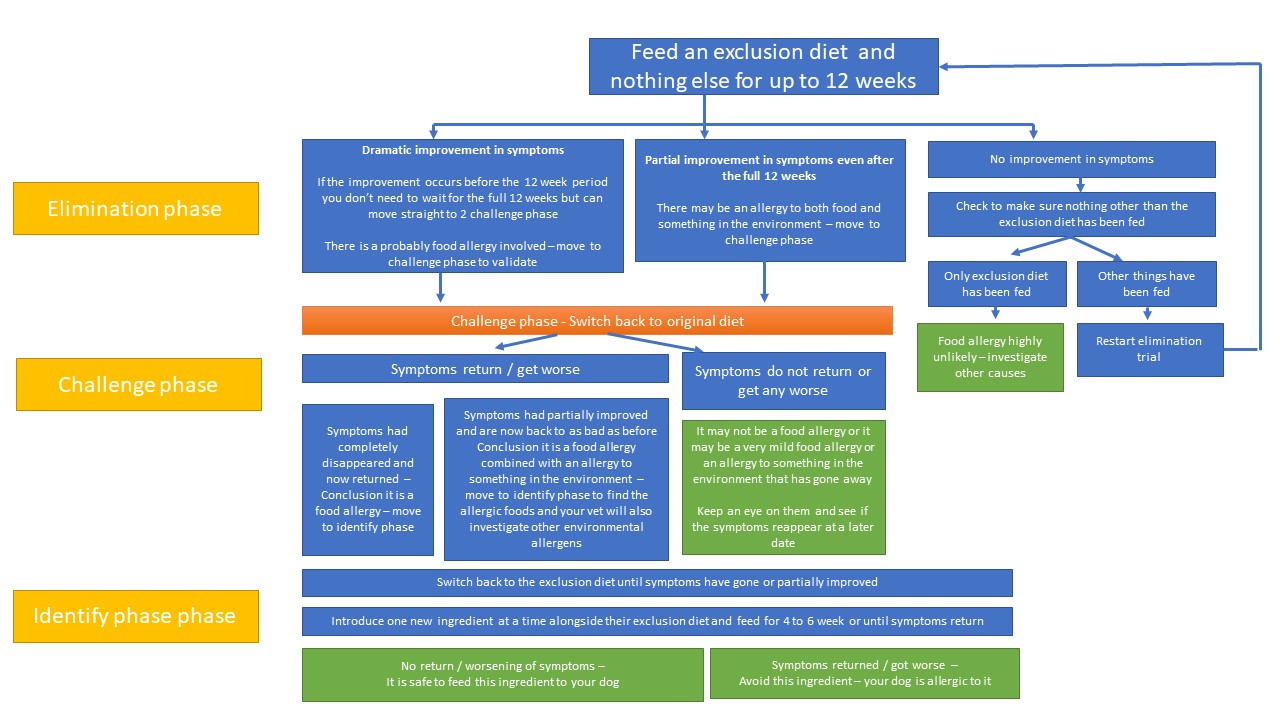
Phase 1 elimination phase
The first phase is called the elimination phase and can take 8 to 12 weeks, although it could be shorter.
In this phase, you switch your dog to a diet that is almost certain to contain no allergic ingredients, and you feed them only that food. The aim is to see whether their symptoms disappear or improve on this allergen-free diet.
The reason it takes so long is that the body needs time to "detox" from any allergens in their system. If symptoms clear up before the full 12 weeks, then you could move to the phase 2 challenge more quickly.
If the main symptoms are vomiting or diarrhoea then you should start to see improvements after 2 or 3 weeks. If the main symptoms are itchy or sore skin, you should see improvements after 6 to 8 weeks. However in some dogs it can be slower so keep the trial going for 12 weeks to be sure. If you see improvement for 2 weeks in a row before the 12 weeks is up, then ask your vet whether it is OK to move to the next phase – the challenge phase
In this phase you will see one of these things:
- No improvement in symptoms after 12 weeks – if the trial has been done properly and nothing else has been eaten, then this says it is very unlikely that your dog has a food allergy, and you and your vet can look to see what else is causing the problem.
- Complete clear-up of symptoms for 2 weeks in a row – If that happens, then it may be that your dog has a food allergy – although you will need to do the next phase to be sure.
- Some improvement of symptoms but not completely cleared up after 12 weeks – this could mean that your dog has a combined allergy, so the removal of problem-causing foods has helped fix the food allergy – but they are still reacting to something in the environment.
If they have had partial or complete improvement in their symptoms, then that calls for the next phase of the trial – the diet challenge phase.
Phase 2 - Challenge Phase
Why do you need to do the challenge phase – the symptoms cleared up during the first phase, it must be a food allergy? – however that’s not necessarily true.
The reason this stage is needed is it might not be the change of food that caused the symptoms to go away – it could be that something in the environment changed at the same time, and the allergy has nothing to do with food. Without checking this, you will be trying to avoid certain types of food when there is no need.
In the diet challenge phase, you reintroduce their old food and see what happens.
- If they had a complete clear-up of symptoms before and the symptoms come back when you reintroduce the old diet, then that confirms that it is a food allergy.
- If their symptoms had improved but not totally disappeared, and they get worse again when you reintroduce the old diet, they have an allergy to both food as well as something else in the environment.
- If the symptoms do not return or worsen then it may not be a food allergy after all
This phase could take up to 8 to 12 weeks, as it can take that long for you to see a change in their symptoms but could be shorter if their symptoms flare up more quickly.
Phase 3 - Identification Phase
The purpose of this phase is to identify what they can and can't safely eat.
If you are happy to keep them on the exclusion diet permanently then don’t need to do this phase and can just keeping that diet because you know it works for them
What you need to do is try out different foods in small quantities one at a time to see if they are OK.
Because it’s mostly proteins that cause the problems its best to start with them
You know your dog is OK with the exclusion diet that you used, so feed them that until the symptoms clear up or improve for 5 days in a row. Then add in a small, cooked potion of one new ingredient for up to 2 weeks for instance, add some fish to their diet. Feed that for 2 weeks, and if the symptoms stay away, then you know they are OK with fish.
Then try to add another ingredient, for instance, chicken – if their symptoms flare up when you add chicken, then you know that chicken has to be avoided.
In this way, you can build up a picture of what they can and can't eat and so can move off the exclusion diet. It is a slow process but it’s the best way to find out what you can feed and what you should avoid
MAKE A PRETTIER VERSION OF THIS
What about treats, table scraps, supplements, topper?
There is one very simple rule for an elimination trial. They can only eat the recommended exclusion diet – nothing – absolutely nothing else. Treats, table scraps, bits of food they pick up on the floor after a child has dropped it, supplements, something they found while walking, flavoured chews, toppers, even toothpaste – none of these.
If they eat anything else, at all, then you invalidate the trial as any of these could contain the allergen, and you will need to go back to the beginning and start the trial again.
You can continue to give them medication prescribed by your vet, just tell the vet what they are taking and check that it is OK.
SPECIFIC elimination diets include dry food, wet food and treats - al of which can be eaten as they al share the same basic ingredienst
Supporting your dog during the elimination trial
There are two main jobs you have
Maintain strict diet control
It is vital that only the foods recommended by the vet are fed – you need to make sure your dog doesn’t eat anything else. Remember to make sure that other people such as children, neighbours, people in the park aren’t feeding him other things. If they do eat something else – don’t panic, just record it in the diary so you can tell your vet
Monitor symptoms
The point of the trial is to see whether the symptoms improve or stay the same, so you need to closely watch the symptoms and record what you see.
This elimination trial diary wil help you recored the symptoms
Click here for a free Elimination trial monitoring diary
FAQ's
Recommended for elimination trials in dogs
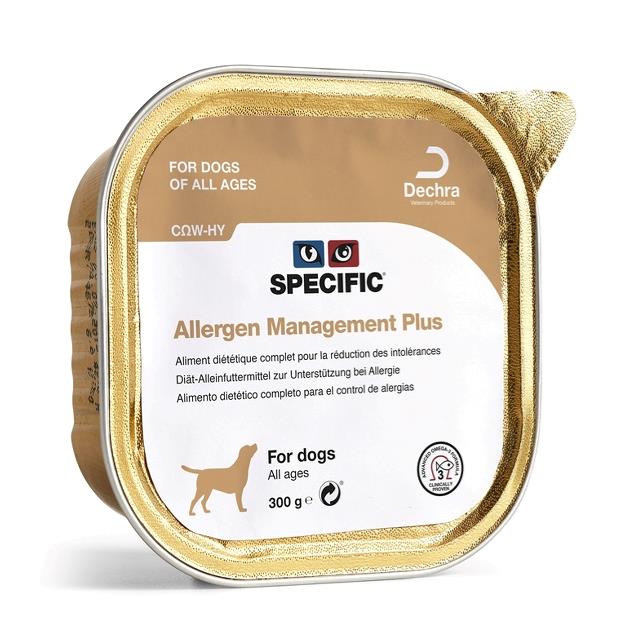
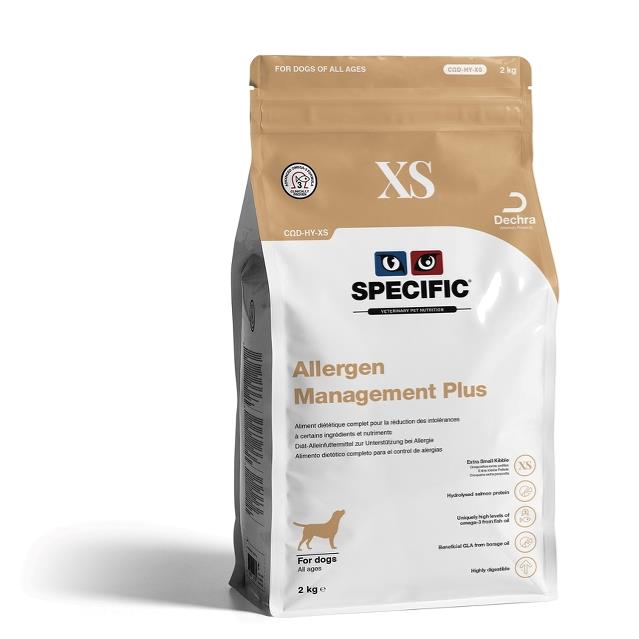
Allergen Management Plus
Food with hydrolysed protein and special fatty acids for the multi-allergic dog
Allergen Management Plus
Tasty wet food pâté with hydrolysed protein for the multi-allergic dog